
What is in Newcastle and Hunter tap water, and which filter fixes what
We may earn a commission when you buy through links on this page.Paid links: we may earn a commission. Between equal products or shops, one that pays us can go first. How this works.
Philips FastFlow AUT9333/79 under-sink filter with tap
WaterMark-listed, certified for chlorine taste and for PFAS.
$299 at Bunnings, checked 22 Oct 2026 · Amazon's price is on its page
Paid links: we may earn a commission. As an Amazon Associate I earn from qualifying purchases. It doesn't change which product is here.
Our picks at a glance
| Product | KitchenPhilips FastFlow AUT9333/79 under-sink filter with tap $299 at Bunnings | ShowerPhilips 3-stage shower filter, KDF and double mesh Price at the retailer | FluoridePhilips 75 GPD reverse osmosis tap water station with remineraliser $499 at Bunnings |
|---|---|---|---|
| Install | Licensed plumber, with its own filter tap | — | Plumbed, licensed plumber |
| Why it's here | WaterMark-listed, certified for chlorine taste and for PFAS. | Chlorinated supply, so KDF is the right media. | WaterMark-listed reverse osmosis, so a licensed plumber can fit it. RO is the only common home method that removes fluoride. |
| Watch out for | Replacement cartridge price not published in Australia when we checked (22 Oct 2026) | Cartridges need replacing every few months | A tank system, so it fills the cupboard and sends water to the drain like any tank RO |
| Buy | Today's price on Amazon$299 at Bunnings | Today's price on Amazon | Today's price on Amazon$499 at Bunnings |
WaterMark-listed, certified for chlorine taste and for PFAS.
WaterMark-listed, certified for chlorine taste and for PFAS.
Watch out: Replacement cartridge price not published in Australia when we checked (22 Oct 2026)
- Install: Licensed plumber, with its own filter tap
$299 at Bunnings, checked 22 Oct 2026 · Amazon's price is on its page
Chlorinated supply, so KDF is the right media.
Chlorinated supply, so KDF is the right media.
Watch out: Cartridges need replacing every few months
Price at the retailer
WaterMark-listed reverse osmosis, so a licensed plumber can fit it. RO is the only common home method that removes fluoride.
WaterMark-listed reverse osmosis, so a licensed plumber can fit it.
Watch out: A tank system, so it fills the cupboard and sends water to the drain like any tank RO
- Install: Plumbed, licensed plumber
$499 at Bunnings, checked 9 Nov 2026 · Amazon's price is on its page
Quick answer: Newcastle and Lake Macquarie water comes mainly from the Grahamstown plant, with hardness of 46 to 74 mg/L (median 56), free chlorine at a median of 1.3 mg/L and fluoride at about 0.99 mg/L, according to Hunter Water's typical composition table updated August 2025. Hunter Water calls its water soft and non-scaling. Any carbon or KDF filter handles the chlorine; only reverse osmosis removes the fluoride.
How we picked: We picked these 3 from the water filters sold in Australia, judged on install and price, using maker specs, Australian retailer prices and owner reports. We haven't tested them hands-on yet, and maker claims are labelled as theirs. Commission never puts a worse product ahead of a better one, but between equal products or shops, one that pays us can go first. Full method.
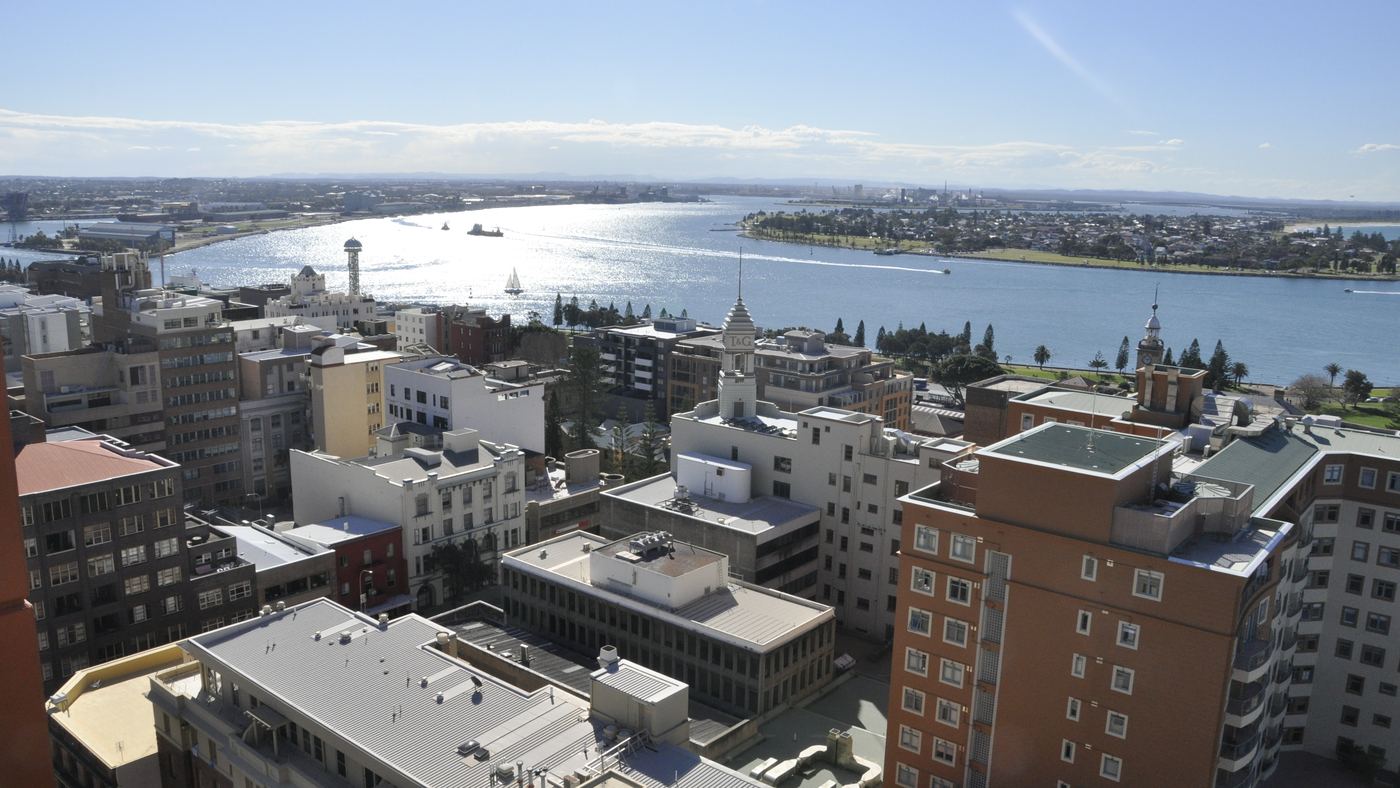
Hunter Water publishes more useful numbers than most utilities, plant by plant, and they tell a simple story: soft, chlorinated, fluoridated water that needs very little filtering. Here is the detail and what to buy.
Where the water comes from
Hunter Water supplies more than half a million people in the Lower Hunter from several treatment plants. Newcastle and Lake Macquarie are typically supplied by Grahamstown (fed by Grahamstown Dam and the Tomago sandbeds) and Dungog (Chichester Dam). Maitland, Cessnock and Kurri are typically on Dungog. Port Stephens is on Anna Bay, Nelson Bay, Lemon Tree Passage and Grahamstown. The supply zones can switch, so Hunter Water publishes ranges rather than single figures.
The numbers, plant by plant
All from Hunter Water’s Typical Composition of Supplied Drinking Water, updated August 2025, covering 1 June 2020 to 31 May 2025; figures are 5th percentile, median and 95th percentile.
| Plant | Typically supplies | Hardness (mg/L CaCO₃) | Chlorine (mg/L) | Fluoride (mg/L) | TDS (mg/L) |
|---|---|---|---|---|---|
| Grahamstown / Tomago | Newcastle, Lake Macquarie, Raymond Terrace, Medowie, Stockton | 46 to 74, median 55.9 | 1.0 to 1.7, median 1.3 | 0.09 to 1.03, median 0.99 | 131 to 193, median 157.5 |
| Dungog | Maitland, Cessnock, Kurri, Thornton, Dungog | 39 to 61, median 49 | 1.3 to 1.6, median 1.4 | 0.03 to 1.03, median 0.97 | 68 to 128, median 97.5 |
| Anna Bay | Anna Bay, Salamander, Soldiers Point, Corlette | 49 to 67, median 60.9 | 1.4 to 1.7, median 1.6 | 0.94 to 1.02, median 0.98 | 124 to 144, median 134 |
| Lemon Tree Passage | Lemon Tree Passage, Karuah, Mallabula | 18 to 77, median 68 | 1.1 to 2.6, median 1.9 | 0.94 to 1.03, median 0.98 | 106 to 171, median 132 |
| Nelson Bay | Nelson Bay, Fingal Bay, Shoal Bay | 12 to 35, median 17.1 | 1.3 to 2.4, median 1.9 | 0.93 to 1.02, median 0.98 | 107 to 177, median 139 |
The chlorine figures are Hunter Water’s plant medians and percentiles as listed; the aesthetic guideline it reports against is 0.6 mg/L and the health guideline 5 mg/L. pH across all plants runs 7.3 to 7.6.
The three things that matter
Chlorine, not chloramine. Hunter Water chlorinates and explains why on its What’s in your water page. Residuals of 1 to 2 mg/L are typical of a utility that keeps a firm residual to the ends of its network, and the Port Stephens plants run a little higher. Any carbon filter in the kitchen and a KDF filter in the shower handle it; no catalytic carbon or vitamin C is needed.
Soft water. Hunter Water’s own hardness fact sheet puts all its sources in the NHMRC “soft” or “good quality” bands and describes them as soft, non-scaling waters at room temperature. Newcastle at a median of 56 mg/L sits a little above Sydney (about 43) and well below Adelaide and Perth. There is no case for a softener.
Fluoride. Just under 1 mg/L at every main plant, added under NSW legislation. It passes through carbon. The fluoride guide covers what removes it.
What to buy in Newcastle and the Hunter
- Chlorine taste: any carbon filter. Owners: the Philips FastFlow, WaterMark-listed and certified for chlorine and PFAS. If lead from the old brass fittings common in Newcastle’s inner suburbs and Maitland’s older housing worries you, choose a filter whose own NSF/ANSI 53 listing names lead. Get the water tested first. Renters: the Philips on-tap or a jug.
- Shower: the Philips KDF filter, the right media for a chlorinated supply. See do shower filters work.
- Fluoride: a WaterMark-listed reverse osmosis system such as the Philips 75 GPD station. The cheapest online kits (Geekpure, iSpring) aren’t on the WaterMark register, so a licensed plumber can’t install them. The worth-it guide puts Newcastle in the “only for fluoride” column.
- Scale: nothing. Hunter Water’s words are “soft non-scaling”.
- Tank water in the Hunter Valley: a different problem, covered in the whole-house guide.
- Your own water: test your own tap water with hardness strips or a TDS meter before you buy. The test kit guide covers what a home kit can and can’t tell you, and when to use a NATA-accredited lab instead.
Setting appliances and finding your zone
Hunter Water’s hardness fact sheet gives each plant’s water in the units a dishwasher manual asks for: Grahamstown at 1.68 to 5.88 German degrees, 3 to 10.5 French degrees and 0.3 to 1.05 mmol/L, Dungog softer at 0.84 to 3.08 German degrees. Set the dishwasher to soft and skip the salt. The same page that holds the composition table links a water supply zones map and the monthly water quality reports, which is how to find which plant feeds your street before you buy anything that depends on the number. Hunter Water also notes that silica should stay under 80 mg/L to limit scale; its plants run at 1 to 15 mg/L, which is another reason scale is not a Hunter problem.
The one trap
Treating the Hunter as one supply. Nelson Bay’s water at a median hardness of 17 mg/L is among the softest in the country; Lemon Tree Passage, twenty minutes away, reads 68 with the highest chlorine median in the table. Hunter Water publishes a supply zones map alongside its composition table. Find your zone before buying anything that depends on the number, and re-check it if the taste changes, because zones can be switched between plants.
Sources: Hunter Water, Typical Composition of Supplied Drinking Water (updated August 2025); Hunter Water, Water Hardness fact sheet (May 2014); Hunter Water, What’s in your water; Australian Drinking Water Guidelines (NHMRC). The city comparison sets these figures beside the other capitals.
Where to buy our picks
- Philips FastFlow AUT9333/79 under-sink filter with tapSee today's price on Amazon
- Philips 3-stage shower filter, KDF and double meshSee today's price on Amazon
- Philips 75 GPD reverse osmosis tap water station with remineraliserSee today's price on Amazon
Paid links: we may earn a commission. As an Amazon Associate I earn from qualifying purchases. Prices change; the shop's page is the final word.
The picks in detail
Tap a pick for its full specs, pros and cons and every shop.
KitchenPhilips FastFlow AUT9333/79 under-sink filter with tap
$299 at Bunnings · checked 22 Oct 2026Specs, pros and cons, all 2 shops
WaterMark-listed, certified for chlorine taste and for PFAS.
- Certification: NSF/ANSI 53 for PFAS (PFOS and PFOA), 42 for chlorine, 401 for microplastics, plus 372 (Philips and Bunnings listings, 31 Oct 2026)
- WaterMark: Yes, licence 060212
- Install: Licensed plumber, with its own filter tap
- Cartridge life: 7,268 L or 12 months (Philips, Bunnings listing); certified for 1,925 US gal
- Yearly running cost: Not published in Australia when we checked (22 Oct 2026)
Pros
- The only under-sink filter we compared with both WaterMark and NSF/ANSI 53 certification
- Certified for PFAS, not just chlorine
- Its own filter tap, so your mixer stays as it is
Cons
- Replacement cartridge price not published in Australia when we checked (22 Oct 2026)
- Needs a plumber and a hole for the tap
Paid links: we may earn a commission. As an Amazon Associate I earn from qualifying purchases. Price checked 22 Oct 2026.
ShowerPhilips 3-stage shower filter, KDF and double mesh
See retailer · checked 9 Nov 2026Specs, pros and cons and where to buy
Chlorinated supply, so KDF is the right media.
- Media: KDF plus mesh stages
- Fits: Standard shower arm thread
- Reduces: Chlorine (manufacturer claim)
- Cartridge life: 4-6 months or 50,000 L (Philips claim)
Pros
- Sold and shipped by Amazon Australia
- KDF is the media with real evidence for chlorine reduction
- Fits before your existing shower head
Cons
- Cartridges need replacing every few months
- Slight reduction in flow
Paid links: we may earn a commission. As an Amazon Associate I earn from qualifying purchases. Price checked 9 Nov 2026.
FluoridePhilips 75 GPD reverse osmosis tap water station with remineraliser
$499 at Bunnings · checked 9 Nov 2026Specs, pros and cons, all 2 shops
WaterMark-listed reverse osmosis, so a licensed plumber can fit it. RO is the only common home method that removes fluoride.
- Output: 75 GPD
- Remineraliser: Yes
- Install: Plumbed, licensed plumber
- Certification: WaterMark, licence 060214
- WaterMark: Yes, licence 060214
- Yearly running cost: About $215 to $335 at Philips RRP (AUT515, AUT514, AUT521 sets)
Pros
- RO with remineralisation from a brand you can buy in-store
- Bunnings warranty and returns
Cons
- A tank system, so it fills the cupboard and sends water to the drain like any tank RO
Paid links: we may earn a commission. As an Amazon Associate I earn from qualifying purchases. Price checked 9 Nov 2026.
Frequently asked questions
Is Newcastle water hard or soft?
Soft. Hunter Water's typical composition table (August 2025, five years of data) gives hardness at the Grahamstown plant, which supplies Newcastle and Lake Macquarie, of 46 to 74 mg/L with a median of 55.9. Its hardness fact sheet describes all Hunter Water supplies as soft, non-scaling waters. Dungog is softer again at a median of 49 and Nelson Bay at 17.
Does Hunter Water use chlorine or chloramine?
Chlorine. Hunter Water's What's in your water page asks and answers why the water is chlorinated, and its composition table reports chlorine at a median of 1.3 mg/L from Grahamstown, 1.4 from Dungog and up to 1.9 at Lemon Tree Passage and Nelson Bay. Standard carbon and KDF filters work.
Is Newcastle water fluoridated?
Yes, as required under NSW legislation. The composition table gives a fluoride median of 0.99 mg/L at Grahamstown and 0.97 to 0.98 at the other main plants, against the 1.5 mg/L health guideline. Gresford's small supply reads 0.13, so it is not fluoridated. Carbon does not remove fluoride; reverse osmosis does.